Hey guys, I’ve recorded a new tutorial showing how to simulate some party balloons with ICE and a small dose of vector math. 🙂
Part 1:
Part 2 will come soon.
Hey guys, I’ve recorded a new tutorial showing how to simulate some party balloons with ICE and a small dose of vector math. 🙂
Part 1:
Part 2 will come soon.
Here’s a two-part series to understand the basic vector math behind a simple push, and elaborating on it:
If you enjoyed this, don’t forget to like TD Survival on Facebook to get the latest news of future videos and whatnot. (New content posted almost every week!)
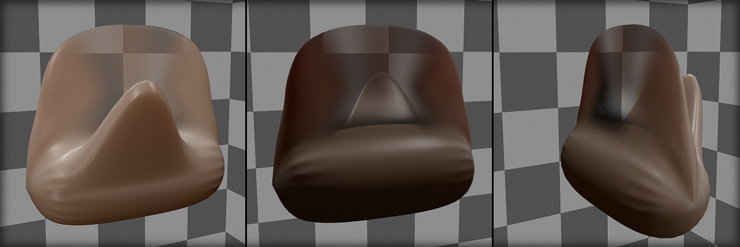
Ever played with the ElasticReality morpher node in the FXTree? 🙂
You can call me a numerophobe when naming rig objects, but the reason I personally avoid numbers in my rigging naming conventions (99% of the time) is so that when I duplicate something, a number at the end won’t increase by itself because there isn’t one. (The issue can be circumvented by having numbers somewhere before the end, but I’m the kind of weirdo that prefers to go with letters altogether.)
We humans work numbers in what’s known as the “Numeral system“, also known as the “base 10” system (as we have that many fingers…) but hold on… the alphabet has 26 letters, not 10, so what do we call that system? It has a name: it’s the Hexavigesimal (or “base 26”) system.
As the ever-so-handy Wikipedia denotes,
Any number may be converted to base-26 by repeatedly dividing the number by 26.
Pretty easy stuff for Python.
This is how I’d do it:
[I shared this on the Softimage Mailing List the other day and thought it was worth posting here.]
Here’s a fun trick for parsing an ICE string attribute, identifying the letters and typing out the text with particles:
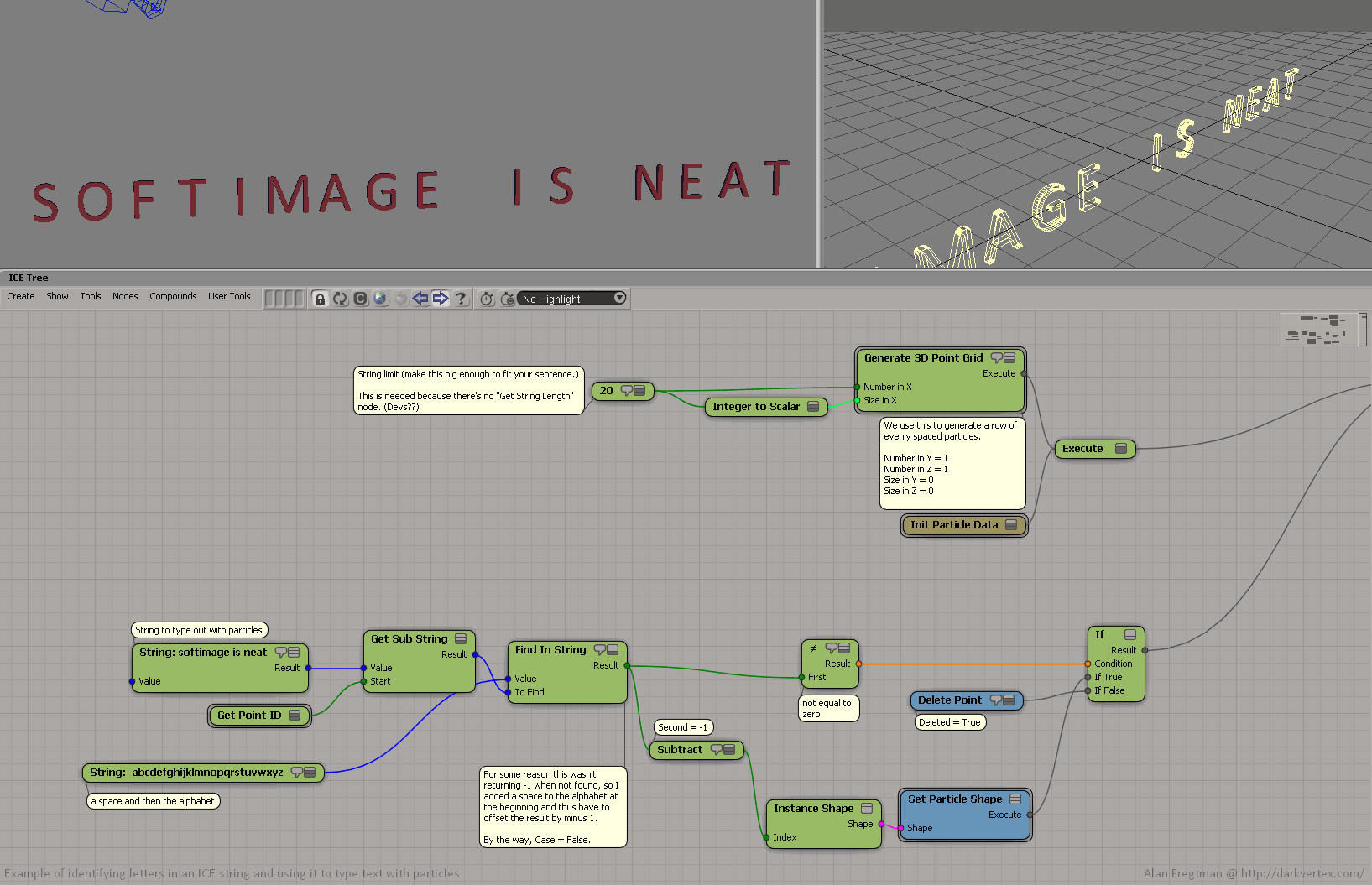
Download the sample scene here and read more about it below. (Soft 2011+ required.)
I propose a way of using ICE to split symmetrical shape halves. Here it is in action:
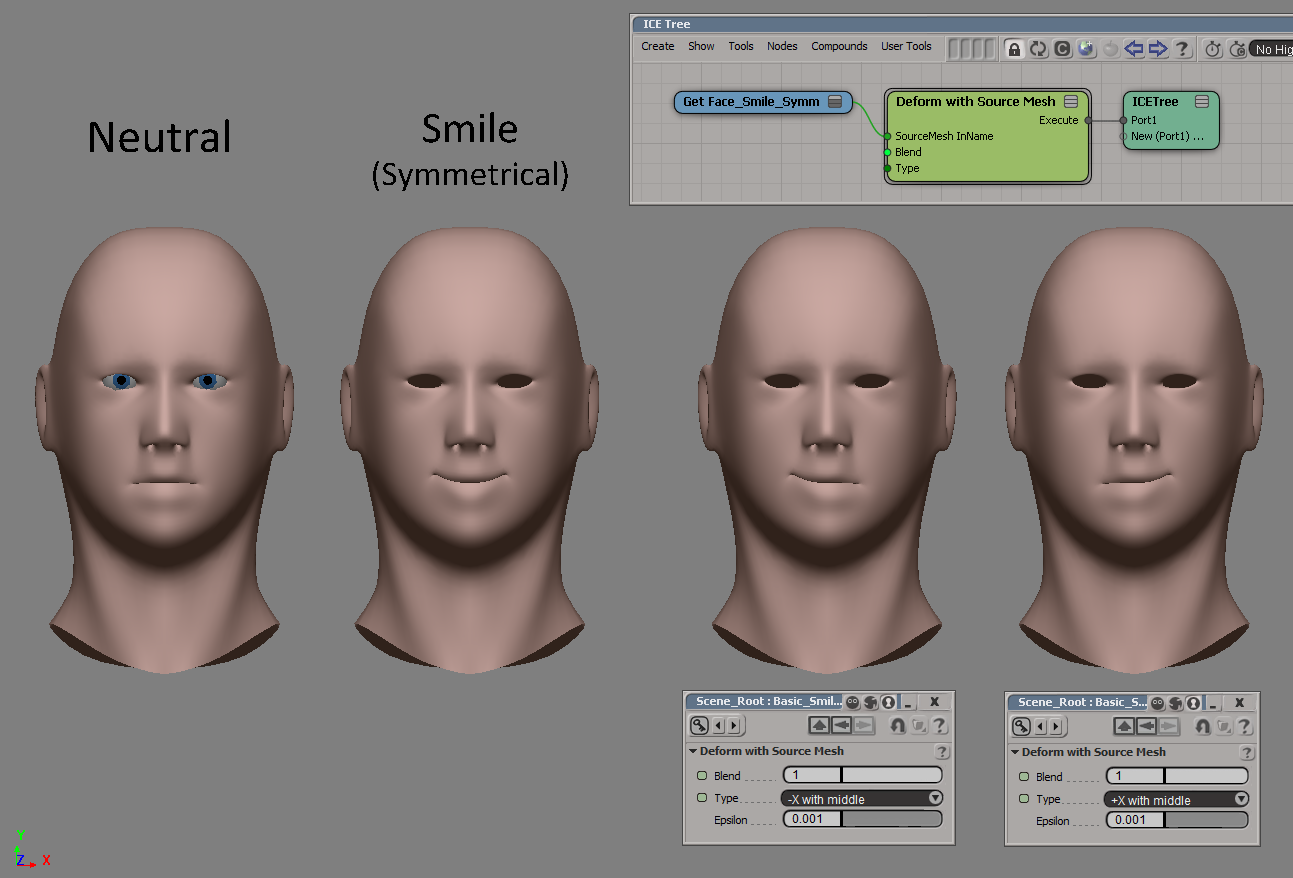
(Download here and read more about it below.)
This post surged from a question at a forum where somebody tried to use the ctr_dist() function — that returns distance between two object centers — in a Softimage script only to realise that actually it only exists for expressions, not scripting.
Here’s my take on said function for both Softimage and Maya…
Which is the fastest way to do this or that? Why not try them all and benchmark! 🙂
All you need to do is lock at the time.clock()…
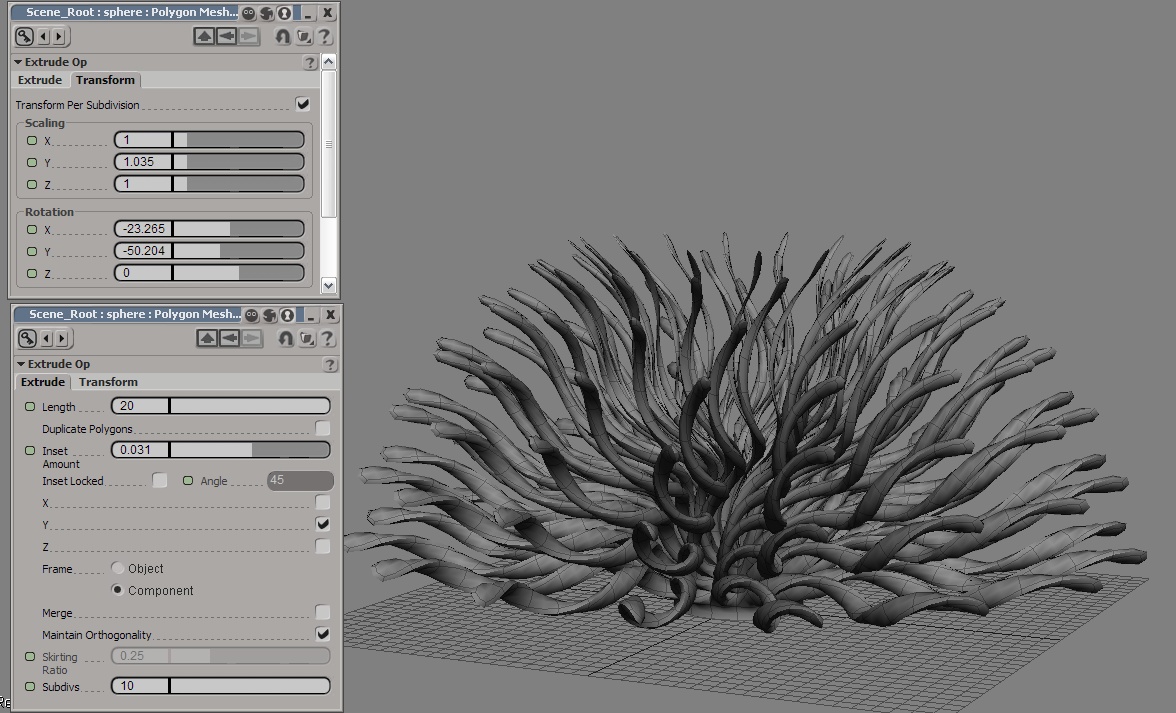
A lot of people are unaware of the possibilities of the ExtrudeOp operator. See below…